



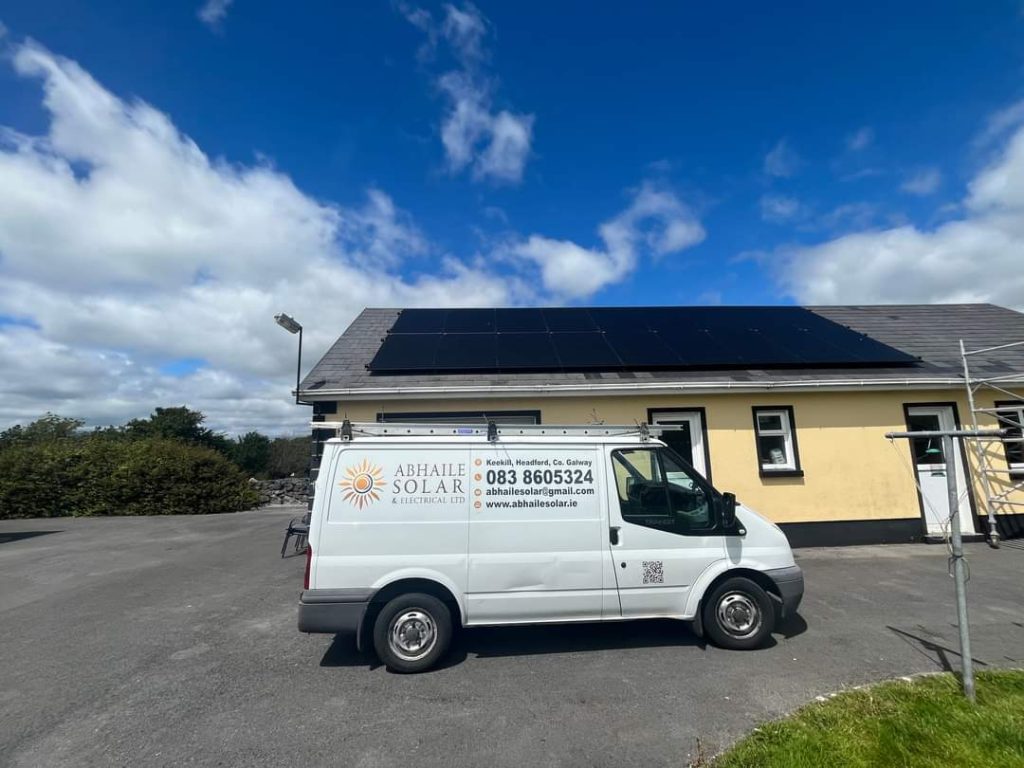
Abhaile Solar installs solar PV systems across Ballinrobe and south Mayo, covering Hollymount, Robeen, Kilmaine, The Neale, Cross, Ballyglass, Partry and out towards Shrule and the shores of Lough Mask. We’re based at Keekill outside Headford, a straight run down the N84 and roughly half an hour from the town, so this is an area we’re in regularly rather than one we travel to occasionally.
The property mix here is broad. Terraced and semi-detached homes along the older streets in town, rural bungalows and dormers on larger sites, working farms across the limestone land east and south of the town, and a steady band of guesthouses, self-catering lets and lakeside holiday properties around Lough Mask and Lough Carra. Each has a different consumption pattern, and that pattern matters more to the outcome than the panels themselves.
We’ve installed over 500 systems nationally with more than thirty years of electrical experience behind the business, and we look after the entire job: free site survey, SEAI grant application, installation, ESB Networks connection and aftercare afterwards.
Town Houses, Rural Bungalows and the Land Around Lough Mask
Homes in the centre of Ballinrobe need the same checks as any older market town property. Slate condition and batten integrity come first, then a workable cable route through a building that wasn’t designed with one in mind. Shared and terraced roofs also need the layout thought through properly, since usable area is tighter than it looks from the street.
Rural properties are generally the easier proposition. Bungalows and dormers around Hollymount, Kilmaine and out towards the lake usually offer generous roof area with little overshadowing, and there’s often a garage or outbuilding with better orientation than the house itself. Most homes out this way are on oil or solid fuel with an immersion for hot water and a pump on a private well, which puts the electrical baseline higher than people expect. That works in your favour when sizing a system, because there’s more demand for the panels to displace.
One point specific to rural south Mayo: some properties sit at the end of long network feeds, and ESB Networks occasionally applies conditions to how much a system can export in those locations. It’s not usually a barrier, but it’s something we identify at survey stage rather than after the fact.
Solar for Guesthouses, Self-Catering and Holiday Homes
Ballinrobe draws visitors for the angling on Lough Mask, the racecourse and the walking, and a good number of local properties are let out rather than lived in year-round. That changes the solar calculation in a way that’s genuinely favourable, and it’s worth understanding why.
A self-catering property or guesthouse is busiest from late spring through to early autumn, which is precisely when a solar system generates most of its annual output. Occupancy and generation peak together, so a high proportion of what you produce gets used on site instead of exported at a low rate. Add showers, laundry and immersion heating running on turnover days and the summer load is substantial.
A private holiday home used only occasionally works differently. With the property empty for much of the year, most generation is exported, so the return leans on export payments rather than bill savings and a large battery is harder to justify. We’ll be straight with you about which of those two situations you’re in and size accordingly.
Farms Around Ballinrobe, Kilmaine and Hollymount
Farm buildings are frequently the better site for an array than the farmhouse. Shed roofs give a large uninterrupted span with minimal shading, and the system connects back into your supply so it serves the whole yard.
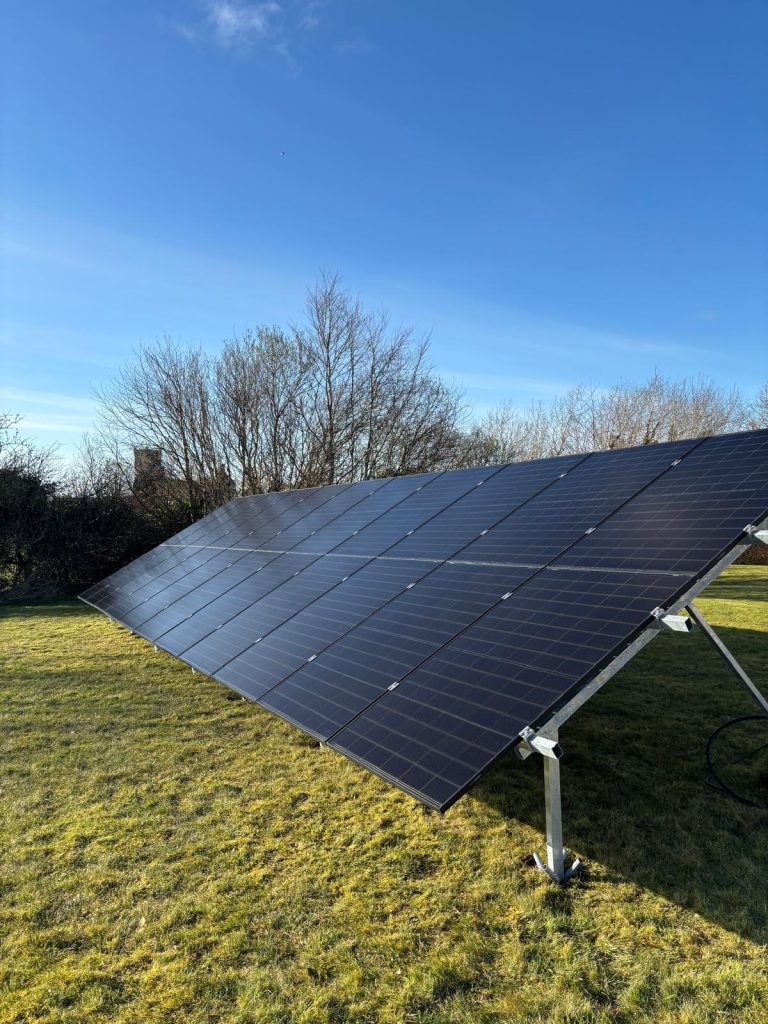
What makes farms work is that the demand lands during daylight. Water pumps, parlour and cooling plant, ventilation, workshop tools and yard lighting all draw power when the panels are producing, so very little is exported at the lower rate. Where the sheds face the wrong way or there’s more roof than demand, a ground mounted array on a corner of poorer ground is often the more sensible option, and space is rarely the constraint around here.
The limiting factor on most holdings is the incoming supply rather than the roof, and single-phase and three-phase installations are approached differently. Both are worked through at survey before anything is proposed.
What South Mayo Households Save
Most households see electricity bills drop by somewhere between 50% and 70%. The variable that decides your position in that range is how much of your own generation you use directly, because electricity consumed as it’s produced is worth considerably more than electricity exported.
Ballinrobe has a mix that cuts both ways. Households working locally in the town or retired are home through the middle of the day and use generation at the point it’s produced, which is the most valuable outcome available. Those commuting towards Galway or Castlebar have an empty house through peak generating hours, and for them the battery is what makes the system worth having rather than an optional extra. We’ll tell you which side you fall on before recommending storage.
SEAI Grants for Ballinrobe Properties
The SEAI Domestic Solar PV Grant of up to €1,800 applies to eligible homes in Ballinrobe on the same terms as anywhere in the country, and it comes straight off the installation cost.
Farms and businesses come under separate SEAI support that scales with the size of the system, so larger agricultural and commercial arrays can attract more funding. Note that the domestic grant covers your own home rather than a property run as a commercial let, so if you’re solar-ing a guesthouse or self-catering unit, that falls under the business route instead. We’ll clarify which applies to you before anything is committed.
We complete and submit the grant application and the ESB Networks NC6 paperwork on your behalf, so there’s nothing for you to file or follow up.
How the Job Runs
Survey and proposal. Send us your Eircode and a recent ESB bill. We survey the property free of charge, assess orientation, shading, roof condition and supply arrangement, then send a written proposal based on what we found on site.
Installation and commissioning. We submit the SEAI grant application, notify ESB Networks and agree a date. Our own team fits the array, connects and commissions the system and sets up your monitoring app before leaving.
Paperwork and aftercare. We finish the documentation, arrange the BER assessment and see the grant through to payment. A five-year labour warranty covers the work, and we’re half an hour down the road if anything needs attention.