



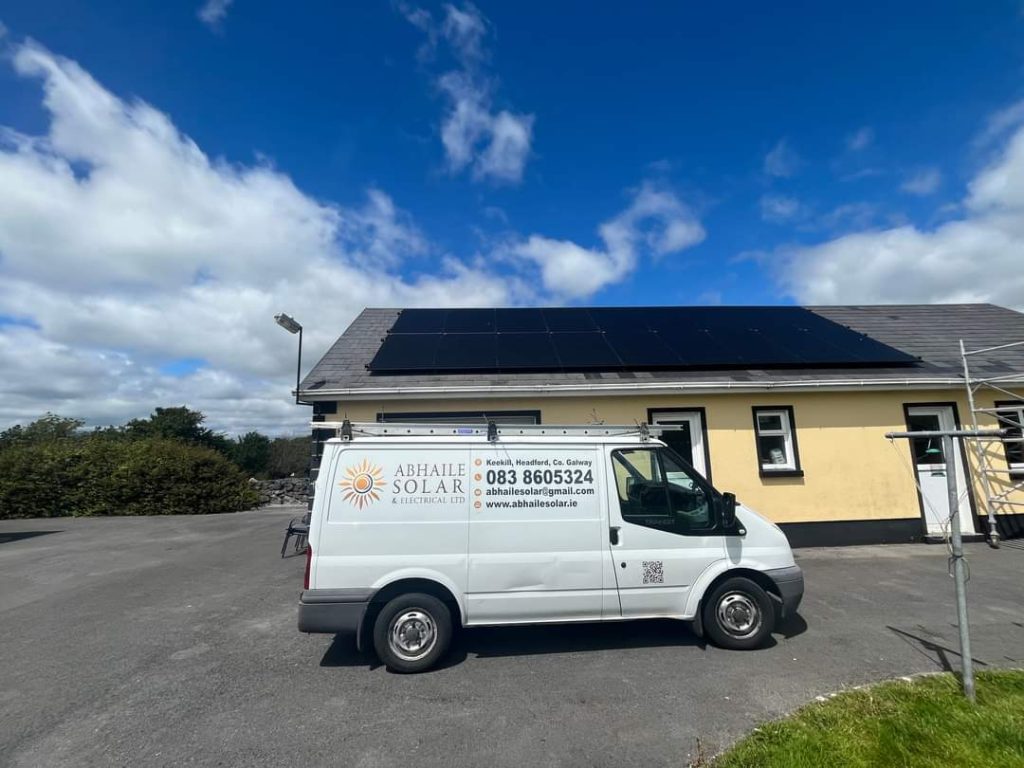
 Abhaile Solar installs solar PV for homes and farms across Turloughmore and the surrounding area, taking in Lackagh, Cregmore, Carnmore, Annaghdown, Kiltulla, Montiagh and out along the N63.
This is limestone country, and the name gives away what that means. Turloughs fill in winter and empty in summer, and the land around here behaves accordingly, with ground that’s dry from May and wet, sometimes very wet, from November onwards. That has almost no bearing on the panels themselves, which sit up on a roof, but it matters a great deal for where the rest of the system goes. It’s one of the few places we work where we spend as long looking at outbuildings and floor levels as we do at roofs.
We’ve completed over 500 installations nationally with more than thirty years of electrical experience behind the business, and we handle the entire job from free survey through to grant payment and aftercare.
Where the Inverter and Battery Actually Live
A solar installation isn’t just panels. There’s an inverter, isolators, usually a consumer unit alteration, and on most jobs a battery, and all of that has to be mounted somewhere sensible. On properties around Turloughmore and Lackagh, that decision deserves more thought than it usually gets.
Damp is the first consideration. An unheated shed with a bare concrete floor, or a garage that takes water in a wet winter, is a poor home for an inverter and a worse one for a battery. Condensation is as much of a problem as standing water, and electronics that spend six months of the year in a cold damp building don’t last as well as ones that don’t.
Flooding is the sharper version of the same problem, and on properties that have had water in an outbuilding before, mounting height matters. Equipment goes high on the wall rather than at low level, and where a building has flooded previously, it’s usually better to find another location entirely.
Batteries have their own requirements. They perform poorly when cold, need clearance around them for ventilation, and are better on a solid wall in a dry, reasonably stable temperature. A utility room, a dry garage or a plant room usually suits. A damp shed at the end of the yard usually doesn’t, whatever the tape measure says.
None of this is complicated once someone has looked at the buildings. It’s exactly the sort of thing a remote quote gets wrong.
Ground Conditions on Turlough Land
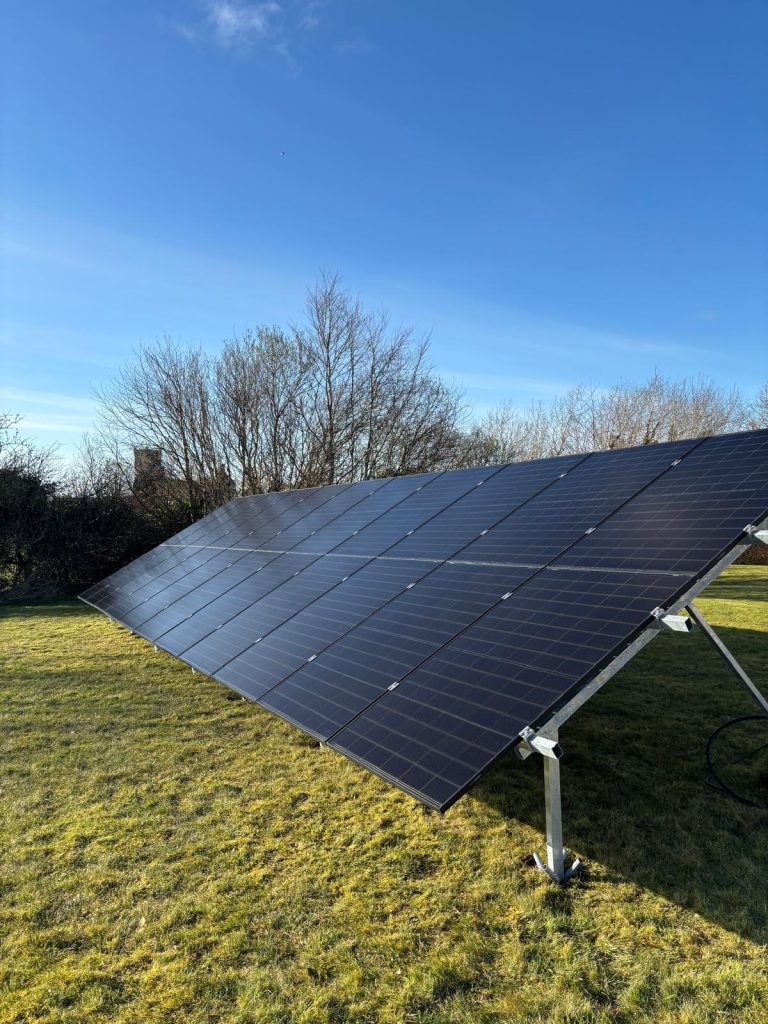
Where a roof isn’t suitable and a ground mounted array is on the table, the same seasonal picture comes into play.
A frame is normally anchored with driven screws, and that needs ground that will hold them, which limestone with a shallow soil covering doesn’t always provide. Land that floods seasonally is a separate question again, since a frame standing in water for part of the winter is not where you want your array, and cable runs across ground that goes under are best avoided entirely.
The practical answer is usually to site the array on the drier ground rather than the most convenient ground, even where that means a longer cable run back to the house. Ground mounted domestic arrays also carry siting conditions under planning that roof panels on a house don’t, so it’s worth checking your position with Galway County Council before settling on a spot. We flag both at survey.
Does Solar Add Value if You Sell the House?
It’s a fair question and it comes up more than you’d expect, particularly from people who aren’t sure they’ll be in the house in fifteen years.
The most concrete effect is on the BER. A solar system contributes to the building’s energy rating, and where the property is otherwise close to a threshold, that can be enough to shift it up a band. A better rating is visible on every property listing and it’s one of the first things buyers filter on, so it isn’t a cosmetic difference.
Beyond the rating, the system stays with the house and so do the manufacturer warranties on the panels, inverter and battery. The practical steps at sale are straightforward: the paperwork, the commissioning documents and the warranty details pass to the buyer, and the export arrangement with the electricity supplier is closed off in your name and set up in theirs, in the same way the account itself is.
The honest caveat is that nobody can promise a specific uplift on sale price, since that depends on the buyer and the market. What can be said is that a well-installed system with proper documentation is an asset to a sale, and a poorly documented one fitted by a company that no longer exists is a question mark. That’s an argument for keeping the paperwork and for using an installer who will still be around.
Homes and Farms Around Turloughmore and Lackagh
The housing here is mostly one-off rural, with bungalows, dormers and farmhouses on their own sites, plus newer development closer to the village and towards Claregalway. Roof area is generally generous and overshadowing limited, which makes for straightforward installations.
Most properties run oil or solid fuel heating with an immersion for hot water, and many are on a well with a pump. Both lift the daytime electrical baseline higher than people assume, which helps the case for solar. On farms, the shed often offers the better roof, though it’s worth establishing which supply the buildings sit on first, since a system feeding the yard meter won’t touch the house bill.
What Households Here Save
Most households see electricity bills fall by roughly 50% to 70%, with the outcome set by how much generation you use directly rather than export.
Turloughmore is close enough to the city that a good share of households are out from morning to evening, exporting their best generation cheaply and buying it back dear at teatime. That’s the specific problem storage solves. Farming households and anyone home during the day are already using generation at the most valuable rate and often need less battery capacity than they’d assume.
SEAI Grants for Turloughmore Properties
The SEAI Domestic Solar PV Grant of up to €1,800 applies to eligible homes here on the same terms as anywhere nationally, coming straight off the installation cost.
Farms and businesses come under separate SEAI support that scales with the size of the system installed. We complete and submit the grant application and the ESB Networks paperwork on your behalf, so there’s nothing for you to file.
From Enquiry to Grant Payment
Survey and proposal. Send your Eircode and a recent ESB bill, or both bills where the house and yard are separately metered. We survey free of charge, assessing the roof, shading, supply arrangement and where the equipment can sensibly be mounted, then issue a written proposal.
Installation and commissioning. We lodge the grant application, notify ESB Networks and agree a date. Our own team fits and commissions the system, connects it and sets up your monitoring app before leaving site.
Documentation and aftercare. We complete the paperwork, arrange the BER assessment where applicable and see the grant through to payment. Keep the documentation somewhere safe, since it’s worth having if you ever sell. A five-year labour warranty covers the work.