



Abhaile Solar installs solar PV for homes, farms and lettings in Clonbur and across Joyce Country, taking in Cornamona, Cross, Ballinchalla, Dringeen and the townlands between Lough Mask and Lough Corrib. We’re based at Keekill outside Headford, about half an hour away.
Two things shape a solar installation here more than they do anywhere else we work, and both come from the landscape rather than the buildings. The first is high ground: hills to the south and west change what a system produces in winter, in a way that a quote drawn up from an aerial photograph will completely miss. The second is that this is the end of the line for the electricity network, and when a storm takes the power out, it can stay out.
We’ve completed over 500 installations nationally with more than thirty years of electrical experience behind the business, and we handle the whole job ourselves, from free survey through to grant payment and aftercare.
Hills, Horizons and Winter Sun in Joyce Country
Most people think about shading in terms of a tree or a chimney. In this part of Galway the more important question is what the horizon looks like, because that’s what governs winter performance.
At midsummer the sun climbs high overhead and clears almost anything. At midwinter it barely gets above about fourteen degrees of elevation at this latitude, which means a hill or a ridge that’s invisible as an obstruction in June can block the sun entirely for part of the day in December and January. With Mount Gable and the Partry hills close by, a good number of properties around Clonbur have a genuinely high horizon in one direction or another.
What this affects is the shape of your generation rather than its total. Annual output is far less damaged than people fear, because the great bulk of it arrives in the months when the sun is high and the hills are irrelevant. What suffers is the winter contribution, which was modest to begin with.
It does influence design. Where high ground sits to the south-west, an array angled to favour morning sun will catch light before the hill takes it, which can be worth more than a textbook south-facing layout. Where the horizon is high to the east, the opposite applies. This is judged by looking at the site and thinking about where the sun actually tracks, which is one of the main reasons we won’t quote here without visiting.
Power Cuts: Backing Up the Circuits That Matter
Out here an outage isn’t just an inconvenience. No power means no water, because the pump stops, and on a farm it means no drinking water for stock either. Storm outages in Joyce Country can run for longer than they would closer to town, so backup is worth taking seriously rather than treating as a luxury.
The starting point is that a standard grid-tied solar system doesn’t help at all. It shuts down automatically the moment the network goes down, which is a safety requirement to protect anyone working on the lines. Backup requires a battery plus either a changeover switch or an Automatic Gateway to isolate the property and run it from stored energy.
The design decision most people don’t know they’re making is what gets backed up. Whole-house backup sounds attractive but a battery has a limited output, and if the immersion, an electric shower or a cooker comes on during an outage it can be overwhelmed in minutes. The more sensible arrangement on most properties is an essential loads board: a separate circuit carrying the things you actually need, typically the water pump, the freezer, lighting, sockets for phones and the boiler controls, while the heavy loads sit outside it and stay off until the power returns.
That approach makes a modest battery genuinely useful in an outage rather than briefly useful. It has to be designed in from the start though, since it involves how the boards are arranged, so raise it at survey rather than after commissioning.
Homes, Farms and Lettings Between the Two Lakes
Rural properties here generally offer good roof area and open aspect, with sheds and outbuildings often better oriented than the house itself. Roof condition is worth checking carefully on older properties, since fitting an array to a roof with a few years left in it means taking it off again later.
Almost everything out this way runs oil or solid fuel heating with an immersion for hot water, and most are on a well with a pump, which lifts the daytime electrical baseline higher than people expect. On hill farms the electrical demand is usually modest, concentrated around pumping, lighting and a workshop, so a smaller system sized to actual consumption will outperform a large one exporting most of what it makes.
For holiday cottages and angling lets, summer occupancy lines up well with peak generation, which means high self-consumption during the season and more export outside it.
What Clonbur Households Save
Most households see electricity bills fall by roughly 50% to 70%, with the outcome set by how much generation you use as it’s produced rather than export.
Households at home during the day, farming or working locally, are already consuming at the most valuable rate. Those commuting out towards Headford or the city have an empty house through the best generating hours, and for them storage is what turns midday output into evening savings. Given how thin generation is here between November and February, particularly on sites with a high horizon, a battery on a smart tariff also earns its keep charging on the cheap night rate and discharging through the evening peak.
SEAI Grants for Clonbur Properties
The SEAI Domestic Solar PV Grant of up to €1,800 applies to eligible homes here on the same terms as anywhere in the State, coming straight off the installation cost.
Farms and businesses, including commercially let accommodation, come under separate SEAI support that scales with the size of the system. We complete and submit the grant application and the ESB Networks paperwork on your behalf.
From Enquiry to Grant Payment
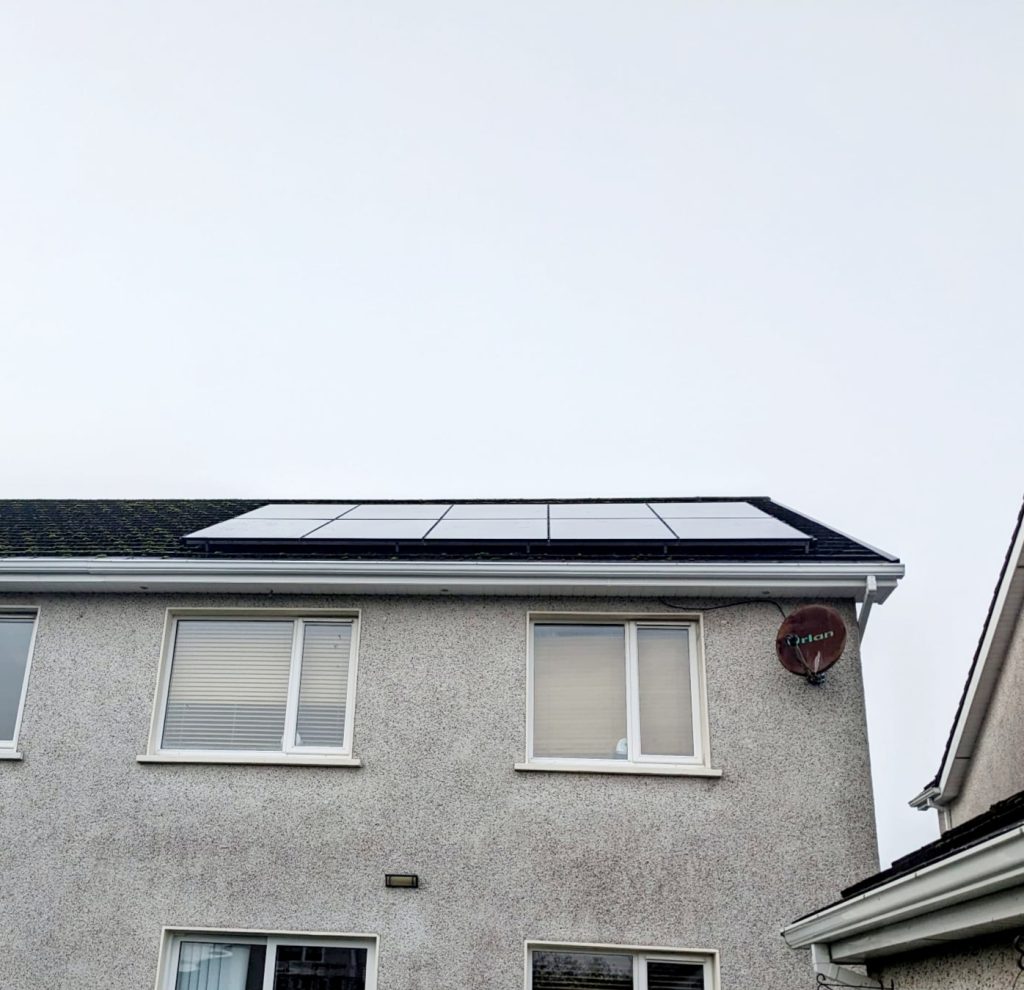
Survey and proposal. Send your Eircode and a recent ESB bill. We survey free of charge, assessing roof condition and orientation, horizon and shading, supply arrangement and what you’d want backed up in an outage, then issue a written proposal.
Installation and commissioning. We lodge the grant application, notify ESB Networks and agree a date. Our own team fits and commissions the system, sets up any backup arrangement and configures your monitoring app before leaving.
Documentation and aftercare. We complete the paperwork, arrange the BER assessment where applicable and see the grant through to payment, with a five-year labour warranty on the work.