



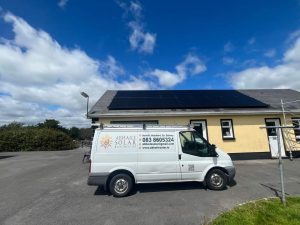
 Abhaile Solar installs solar PV for homes, farms and community buildings around Belclare, taking in Cummer, Kilbannon, Sylane, Castlehacket, Corofin and the townlands under Knockma out towards Tuam.
Most of the work here is what you’d expect in a north Galway parish: rural houses with good roof area, farm sheds, and the usual mix of oil heating, immersion cylinders and well pumps that pushes electricity consumption higher than people assume. But small parishes also have buildings nobody thinks of as solar candidates until someone raises it, and those are often the strongest cases of all.
We’ve completed over 500 installations nationally with more than thirty years of electrical experience behind the business, and we handle the entire job from free survey through to grant payment and aftercare.
Solar for GAA Clubs, Halls and Community Buildings
A clubhouse is close to an ideal solar building, and most committees have never had it costed.
The reason is the hot water. Showers after training and matches are a substantial electrical load, and on a club with several teams using the facilities across a week, water heating is usually the single biggest line on the bill. Add floodlights through the winter evenings, a bar or kitchen with refrigeration running continuously, and heating for the dressing rooms, and the annual consumption on a well-used clubhouse is far higher than the building’s size suggests.
The complication is timing. Club activity is concentrated in the evenings, after generation has fallen away, so panels alone won’t cover it. What does work is directing surplus daytime generation into the hot water cylinders so the immersion has less to do by the time the teams come off the pitch, and adding storage to carry generation into the evening for lighting and general load. Sized properly, the combination takes a real bite out of a bill that most clubs treat as fixed.
Funding is the other half of it. Community buildings don’t come under the domestic grant, but there are routes worth investigating, including SEAI’s community energy supports, LEADER funding through your local development company, and, for sports clubs specifically, the capital programmes that have supported energy upgrades in the past. Eligibility and what’s open at any given time changes, so the practical first step is a conversation with your local development company alongside getting the system costed. We’re happy to put figures on a proposal for a committee to bring to a funder.
Parish halls, community centres and church buildings sit in much the same position: high daytime or evening demand, big simple roofs, and funding routes that domestic customers don’t have.
What the System Looks Like in Twenty Years
Solar is sold on a twenty-five year horizon, so it’s fair to ask what actually happens over that time rather than taking the headline figure on trust.
The panels themselves are the most durable part. They degrade slowly and predictably, typically losing something in the region of half a percent of output per year, which is why manufacturers commonly warrant them to still be producing around 85 to 90 percent of their original output at the twenty-five year mark. There are no moving parts, and beyond keeping the array clear of nesting birds and the odd wash on a low-pitched roof, they need very little.
The inverter is the component to plan for. It’s doing continuous electronic work and it’s the part most likely to need replacing once during the system’s life, usually somewhere around the ten to fifteen year mark. Warranties commonly run to ten or twelve years, and a replacement is a straightforward job rather than a major undertaking. Anyone presenting a twenty-five year payback that ignores an inverter replacement isn’t giving you the full picture.
Batteries are warranted differently again, generally on throughput or cycles rather than years alone, with ten years being a common figure. Capacity reduces gradually over that time rather than failing outright.
None of this undermines the case for solar. It just means the honest version includes one likely replacement along the way, and it’s better to hear that before you buy than after.
Homes and Farms Around Belclare, Cummer and Kilbannon
Rural properties here generally give us plenty to work with: generous roof area, little overshadowing, and often a shed or garage better oriented than the house. On older properties, roof covering and battens want checking first, since fitting an array over a roof nearing the end of its life means removing it again later.
On farms the shed is frequently the better roof, subject to construction and condition. Establish which supply the buildings sit on before anything is designed, because many holdings have separate meters for the house and yard, and a system feeding the yard won’t touch the house bill.
What Households Here Save
Most households see electricity bills fall by roughly 50% to 70%, with the result determined by how much generation you use as it’s produced rather than export.
Farming households and anyone at home during the day are already consuming at the most valuable rate. Households commuting into Tuam or the city have an empty house through the strongest generating hours, and for them storage is what turns midday output into evening savings.
SEAI Grants and Community Funding
The SEAI Domestic Solar PV Grant of up to €1,800 applies to eligible homes here on the same terms as anywhere in the State, and comes straight off the installation cost.
Farms and businesses come under separate SEAI support that scales with the size of the system. Community buildings and clubs fall outside the domestic scheme altogether and are better served by the community and capital funding routes described above.
For domestic and farm work we complete and submit the grant application and the ESB Networks paperwork on your behalf. For a community project we’ll provide a costed proposal in a form a committee can put in front of a funder.
From Enquiry to Grant Payment
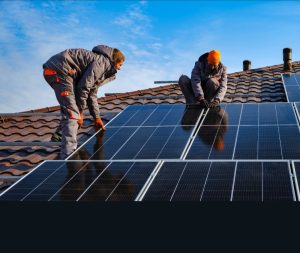
Survey and proposal. Send your Eircode and a recent bill, plus both bills where a house and yard are separately metered. We survey free of charge, assessing roof condition, orientation, shading, supply arrangement and consumption pattern, then issue a written proposal.
Installation and commissioning. We lodge the grant application, notify ESB Networks and agree a date. Our own team fits and commissions the system, connects it and sets up your monitoring app before leaving site.
Documentation and aftercare. We complete the paperwork, arrange the BER assessment where applicable and see the grant through to payment, with a five-year labour warranty on the work.